
Obesity guide
Obesity and food : what the evidence shows
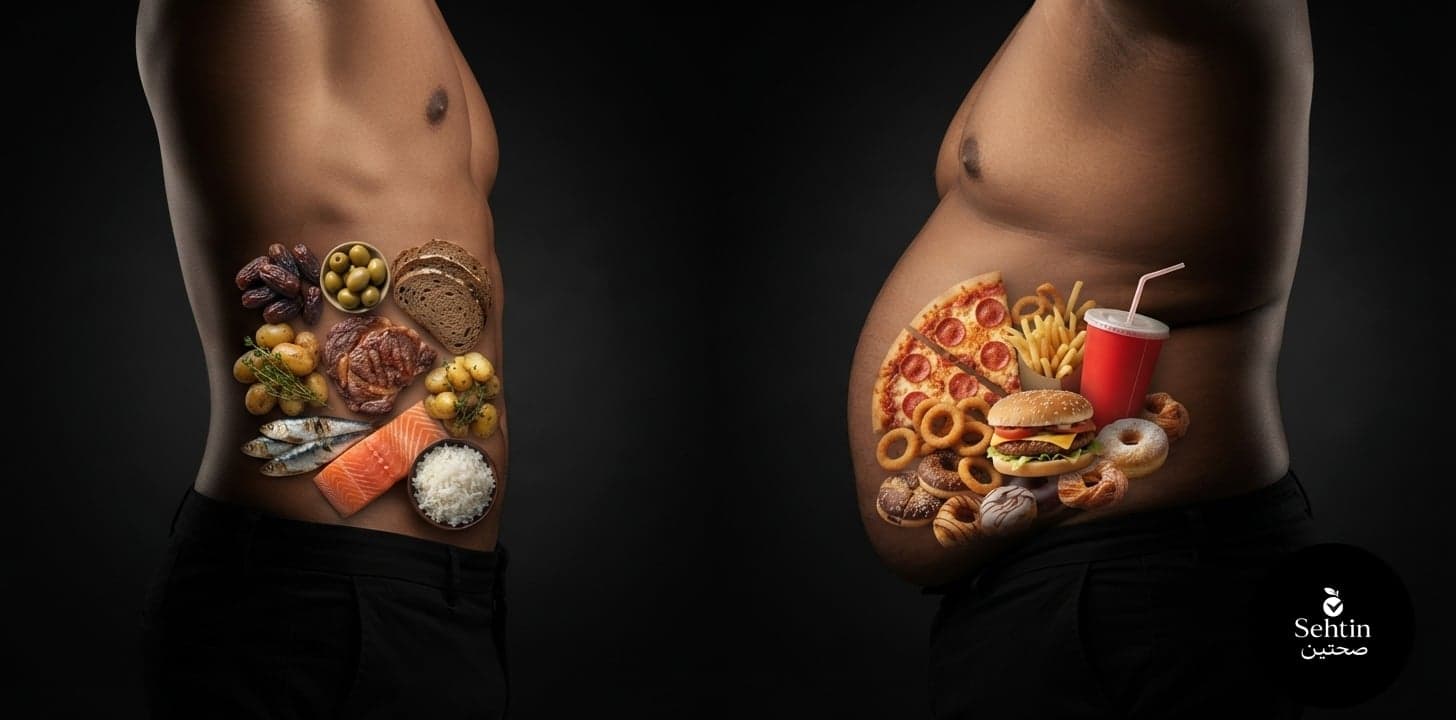
Obesity is classified as a chronic disease, and the reason matters : body weight is defended by hormones, by the liver, by sleep and by the food environment, not by willpower alone. That is also why advice built on shame does not work. This guide sets out what controlled trials actually demonstrate, starting with the one that isolates food processing from calories, then shows where the Tayyibat food filter lines up with that evidence and where it stops. It does not promise a cure, and it never asks you to change a prescribed treatment. Obesity is followed by a doctor, and this page is meant to be read alongside that follow-up, not instead of it.
01
Obesity is a defended state, not a lack of discipline
The clinical definition uses a body mass index of 30 or above, but the number that predicts metabolic risk better is waist circumference : the World Health Organization places the raised-risk threshold at 94 cm for men and 80 cm for women, and the substantially raised threshold at 102 cm and 88 cm. The reason is that fat around the organs and inside the liver behaves differently from fat under the skin. Once that fat accumulates, the body starts defending its new weight : appetite hormones shift, energy expenditure adjusts downward, and the person is fighting their own physiology rather than their character. Any approach that ignores this and simply asks for more effort is not describing the problem correctly.
02
The trial that isolates processing from calories
In 2019 Kevin Hall and colleagues published in Cell Metabolism a randomised crossover trial run entirely inside a research ward. Twenty adults lived on site and ate freely from two diets in turn, two weeks each, matched for calories presented, sugar, fat, fibre and sodium. The only real difference was industrial processing. On the ultra-processed diet, participants spontaneously ate about 500 kcal more per day and gained roughly 0.9 kg in two weeks. On the unprocessed diet they lost about the same. Nobody was told to eat less. This is the strongest single argument for a food filter rather than a calorie count : when the food itself changes, intake follows without effort, and that is precisely the lever a whitelist pulls.
03
What the Tayyibat filter removes, and why that is the whole point
The Tayyibat system does not ask how much, it asks what. Its exclusion list removes white flour and industrial bakery, soft drinks, biscuits, cakes, pizza and pasta, fried snack foods and farmed poultry. Read next to the Hall trial, that list is close to a definition of the ultra-processed category. The allowed side is almost entirely food that has to be cooked : lamb, liver, goat, grass-fed beef, sea fish, rice, freekeh, barley, potato, taro, pumpkin, olive oil, ghee, dates, figs, aged cheese, wholegrain sourdough. A household eating this way does not need to restrict portions to eat several hundred calories less per day, because the food no longer carries the industrial density and the industrial speed that push intake up. The mechanism is not moral. It is textural, and it is measurable.
04
Meal timing : the two-hour rule read against the evidence
Tayyibat asks for a clear gap between eating occasions, with nothing but water, black coffee or green tea inside the window. Controlled work supports the direction. Vujović and colleagues, in Cell Metabolism in 2022, fed sixteen overweight participants identical meals on two schedules, early and late, in a randomised crossover with everything else held constant. Eating late increased hunger, tilted the appetite hormones leptin and ghrelin toward eating more, reduced daytime energy expenditure and shifted gene expression in fat tissue toward storage. Same food, same amounts, different clock, different physiology. That does not prove that a two-hour gap is the exact right number, and the honest position is that the specific interval has not been tested against alternatives. What is supported is the principle : the body treats a late, continuous grazing pattern differently from a bounded one.
05
Protein, satiety, and the order the system puts meat in
Weigle and colleagues showed in the American Journal of Clinical Nutrition in 2005 that raising protein from 15 to 30 percent of intake, with calories initially held constant, cut spontaneous eating by around 441 kcal per day once participants were allowed to eat freely, and produced weight loss without any instruction to restrict. Protein is the most satiating of the three macronutrients, and that is the practical reason a meal built on lamb or fish behaves differently from one built on bread. Tayyibat states a hierarchy rather than a free-for-all : lamb first and up to twice a week, liver once a week at most because it is extremely dense in micronutrients, goat as the lighter alternative, and grass-fed beef last and always boiled at length before being seared in ghee. Sea fish forms its own family, once or twice a week. The system also asks not to combine two animal proteins in the same meal, and to keep a meal to about three main ingredients.
06
The liver is where the story is decided
Fat inside the liver, not fat on the hips, is what drives the insulin resistance that links obesity to type 2 diabetes. Roy Taylor's twin cycle model describes it plainly : liver fat makes the liver ignore insulin and release glucose it should be holding back, which pushes insulin higher, which drives fat into the pancreas, which weakens the cells that make insulin in the first place. The encouraging part is how fast this reverses. Liver fat responds within days to weeks of energy restriction, well before the scale shows much, which is why people often report clearer digestion and steadier energy long before they see a number change. It also explains why waist circumference and how clothes sit are better weekly markers than the scale alone, and why a plateau on the scale is not evidence that nothing is happening.
07
What the large trials actually achieved, and what they did not
Look AHEAD, published in the New England Journal of Medicine in 2013, followed 5145 adults with obesity and type 2 diabetes. Intensive lifestyle intervention produced about 8.6 percent weight loss at one year and held roughly 6 percent at eight years, with better fitness, better glucose control and less sleep apnoea. It did not reduce cardiovascular deaths, and saying so plainly matters. DiRECT, run in British primary care and reported in the Lancet in 2018 and 2019, went further on diabetes itself : 46 percent of participants were in remission at one year and 36 percent at two years, and remission tracked the size of the weight loss closely, reaching around 86 percent among those who lost 15 kg or more. The lesson from both is consistent and sober : diet changes the disease, the size of the change matters, and none of it replaces medical follow-up.
08
Sleep and water, the two levers nobody counts
Taheri and colleagues reported in PLoS Medicine in 2004, on more than a thousand participants in the Wisconsin Sleep Cohort, that short sleep went with lower leptin and higher ghrelin, the exact hormonal combination that makes a person hungrier the next day, and with a higher body mass index. Sleeping badly is therefore not a separate subject from eating : it changes what the appetite asks for. Water belongs in the same practical bracket. Thirst is easily read as hunger, and on the Tayyibat rhythm water is what fills the gap between meals, along with black coffee and green tea, both allowed without sugar and without milk even inside the digestive window. Neither of these two levers will do the work alone. Both make the rest easier to hold, and neither costs anything.
09
Keeping it, and being honest about regain
Fothergill and colleagues, in Obesity in 2016, followed fourteen participants six years after very large rapid weight loss and found resting metabolic rate still below what their body composition predicted, alongside substantial regain. That finding is often quoted to argue that losing weight is pointless. It argues something narrower and more useful : very fast, very large loss leaves a metabolic bill, and the way a person loses weight shapes whether they keep it. This is where a food system has an advantage over a diet with an end date. Tayyibat does not finish, so there is nothing to come off. The rhythm is meant to stay : rotate the cuisines rather than pile ingredients into one plate, keep desserts short and built on fruit and honey, and keep one or two days a week without animal protein. Expect a slower curve than a crash plan, and a curve that does not have to be repeated every January.
FAQ
Frequently asked questions
How much can I realistically lose per month?
In the large lifestyle trials the first-year figure lands around 8 percent of starting weight, which for 100 kg is roughly 2 kg in a good month and less as you go on. Faster than that usually means water and muscle as well as fat. The first two weeks often show a bigger drop that is largely water, so do not read it as the new rate.
Do I have to count calories?
Tayyibat does not use counting, and the Hall trial is the reason the approach can work without it : when the food changes, intake falls on its own. Counting can still help someone who has plateaued for several months, as a temporary measurement rather than a permanent habit.
Can obesity be treated with food alone?
Food is the foundation of every serious approach, and in DiRECT a dietary programme put nearly half of participants into diabetes remission at one year. That is not the same as saying food alone is enough for everyone. Obesity is a chronic disease with medical, genetic and hormonal components, some people need medical or surgical treatment, and that decision belongs to a doctor. Nothing on this page is a reason to delay or stop a treatment.
Does waist circumference matter more than the scale?
For metabolic risk, yes. The waist reflects the fat around the organs, which is the fat that drives insulin resistance, and it moves early. Measure once a week, at the same time of day, at the level of the navel, without pulling the tape tight. A stable weight with a shrinking waist is progress, not a plateau.
I take a medication that causes weight gain. What changes?
Several treatments do raise weight, including some for thyroid conditions, mood, epilepsy and inflammation, and untreated hypothyroidism does too. None of that is a reason to change or stop anything on your own. Tell your doctor that you are changing how you eat, because a diet change can alter how some treatments are dosed, insulin and blood pressure medication in particular. The food side of this page stays valid either way, the pace is simply likely to be slower.
Nothing has moved after a month. What now?
Check the waist before concluding anything, since liver and visceral fat move first. Then look at three things in order : whether the gap between meals is really free of everything but water, coffee and tea, whether sleep is under six hours, and whether the plate has quietly grown. If the waist is genuinely unchanged after eight weeks with those three in place, that is worth raising with a doctor rather than pushing harder, because thyroid function and other treatable causes are worth ruling out.
This article relays the public teachings of Dr. Diaa Al-Awadi for educational and informative purposes. It is not medical advice. Consult your physician before any dietary change. Legal notice.