
Diabetes guide
Tayyibat and type 2 diabetes : what the system offers
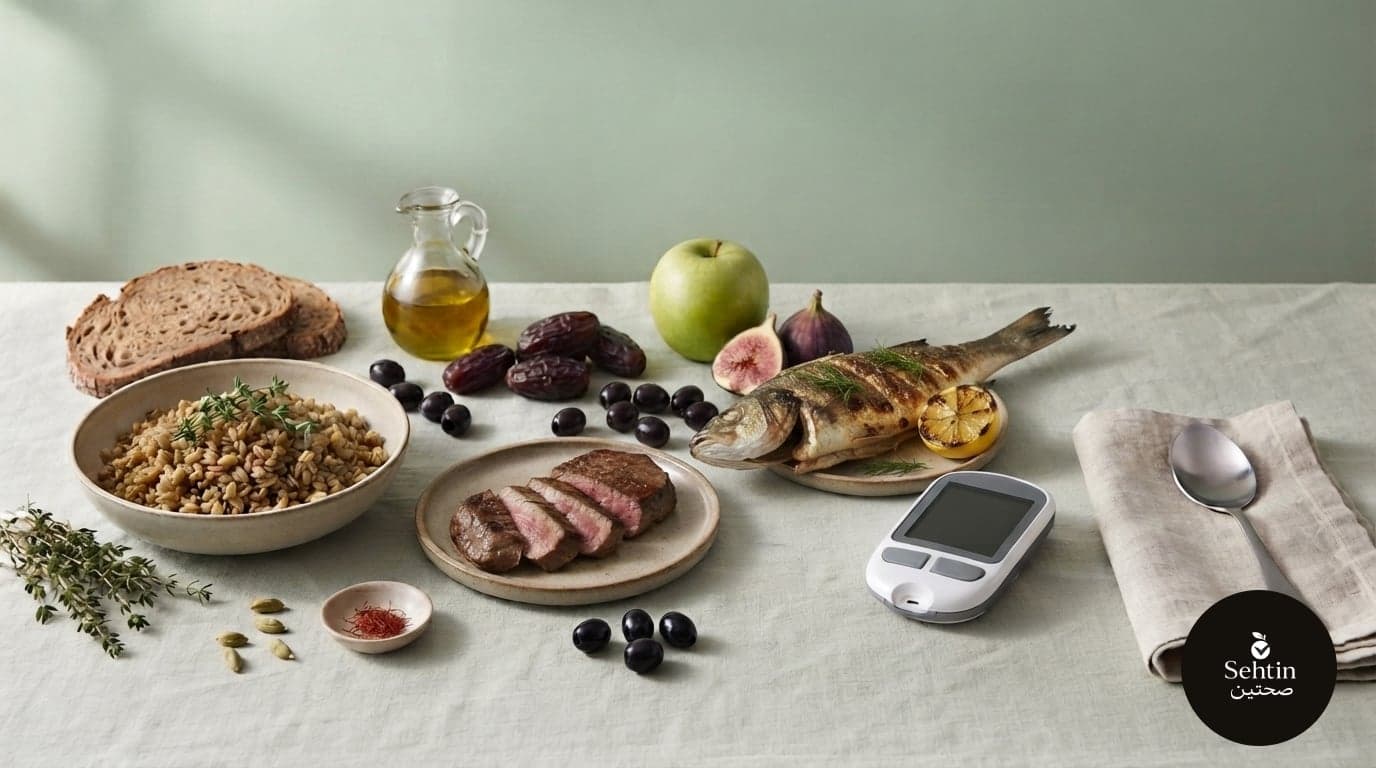
Type 2 diabetes is fundamentally a problem of insulin resistance and chronic high blood sugar. Tayyibat addresses both directly : the 2-hour rule creates daily windows where insulin drops low enough to restore receptor sensitivity, and the food filter excludes the foods (white bread, pasta, sugar, fried items) that spike glucose hardest. This guide is educational only and does not replace your endocrinologist : never stop or alter prescribed medication without medical supervision. We describe how the system intersects with diabetic biology, what dietary adjustments to discuss with your doctor, the foods that have the most stable post-meal glucose response, and the lifestyle adjustments that historically support glucose stability.
01
Remission is documented, and it is not the same as a cure
The word to use is remission. In DiRECT, a trial run inside British general practice and published in the Lancet in 2018 then followed up in Lancet Diabetes and Endocrinology in 2019, a structured weight management programme put 46 percent of participants into remission of type 2 diabetes at one year and 36 percent at two years, with no glucose-lowering medication. Remission there meant a glycated haemoglobin below 6.5 percent sustained for at least two months off treatment. It is a real, measured, repeatable result, and it is not a cure : the underlying vulnerability remains, weight regain brings the diabetes back, and the participants stayed under medical follow-up throughout. Anyone who tells you a diet ends diabetes permanently is going further than the evidence goes.
02
Why it can reverse at all : the liver, then the pancreas
Roy Taylor's twin cycle model explains the mechanism in two steps. Fat accumulating inside the liver makes the liver stop listening to insulin, so it keeps releasing glucose it should be holding back. Insulin rises to compensate, and the excess fat then spills toward the pancreas, where it impairs the beta cells that produce insulin. Both cycles are reversible in the right order, and liver fat is the fastest to move : it falls within days to weeks of an energy deficit, which is why fasting glucose often improves long before any meaningful weight is lost. The pancreas takes longer, and this is where the duration of the diabetes matters more than anything else. In DiRECT, remission was markedly more likely in people diagnosed within the previous six years. Acting early is not a slogan here, it is what the data show.
03
The size of the weight loss decides more than the diet's name
The most useful number in DiRECT is not the headline percentage, it is the gradient underneath it. Among participants who lost 15 kg or more, around 86 percent were in remission at one year. Between 10 and 15 kg the figure was about 57 percent, and below 5 kg it collapsed to roughly 7 percent. Look AHEAD, in the New England Journal of Medicine in 2013, points the same way over a longer horizon : 5145 adults with obesity and type 2 diabetes, about 8.6 percent weight loss at one year, better glucose control and better fitness sustained for years, though without a reduction in cardiovascular deaths. Read together, the two trials say something a marketing page never will : what matters is how much fat actually leaves the liver and the abdomen, and any eating pattern that a person can hold long enough to achieve that is a candidate.
04
Where the Tayyibat filter earns its place
None of the trials above tested Tayyibat, and that has to be said plainly. What supports the approach is the mechanism it shares with them. Kevin Hall's randomised crossover in Cell Metabolism in 2019 kept twenty adults in a research ward and fed them freely from an ultra-processed and an unprocessed diet in turn, matched on calories offered, sugar, fat, fibre and sodium : on the ultra-processed weeks they ate about 500 kcal more per day without being asked to, and gained weight. Tayyibat's exclusion list, white flour and industrial bakery, soft drinks, biscuits, cakes, pizza, pasta, fried snacks, is close to that ultra-processed category, and its allowed side is almost entirely food that has to be cooked. For someone whose glucose depends on both what arrives and how much, that is not a small structural advantage.
05
What food does not do, said plainly
Type 1 diabetes is an autoimmune loss of insulin production. No diet reverses it, insulin is not optional, and nothing on this page applies to it beyond general food quality. In type 2, the honest limits are three. Diabetes of long standing with reduced beta cell function may improve without reaching remission, and that improvement is still worth having. Certain treatments, insulin and sulfonylureas in particular, can cause hypoglycaemia if food intake drops while the dose stays the same, which is exactly why a change in eating has to be announced to the prescriber before it starts and not after. And remission is not permanent : in the DiRECT follow-up, those who regained weight lost the remission with it. A page that omits these three points is selling something.
06
Why the 2-hour rule matters for diabetics
Constant grazing keeps insulin permanently elevated, which is exactly the state that drives type 2 diabetes deeper. The 2-hour rule forces three daily windows where insulin can fall back. Over weeks, this restores receptor sensitivity, the cells respond to less insulin, and HbA1c often drops. Many practitioners report measurable HbA1c improvements between week 6 and week 12. This is not a cure, it is a biological lever ; medication adjustments are decided exclusively by your doctor.
07
The Tayyibat carbs that diabetics tolerate
Whole sourdough bread, freekeh, basmati rice in moderate portions (60-80 g raw), sweet potato, pumpkin, taro. These have a slow glycaemic release because the system pairs them with fat (ghee, butter, olive oil) that further blunts the post-meal spike. White bread, pasta, biscuits, cake, fruit juice and sodas are completely excluded. Many diabetic practitioners observe that they tolerate Tayyibat carbs without medication adjustment whereas equivalent calories of white bread spike them dangerously.
08
What to discuss with your endocrinologist
Bring your current meal plan, your HbA1c trajectory, your medication list. Show the proposed Tayyibat plan. Ask : will my morning fasting glucose change ? Should I monitor more frequently in week 1 and 2 ? Is there a risk of hypoglycaemia if I cut sugars while still on metformin or sulfonylureas ? Insulin-dependent diabetics need careful supervision because the system can rapidly improve sensitivity, requiring dose reduction. Never adjust insulin dose without your doctor.
FAQ
Frequently asked questions
Can Tayyibat reverse type 2 diabetes?
The system can support remission in some early-stage cases when combined with weight loss and medical follow-up. It is not a guaranteed cure and never replaces medical decisions.
Are dates safe for diabetics on Tayyibat?
Two to three dates with a fat (cream, butter, ghee) cause a minor glucose response thanks to the fat-fibre combination. Eaten alone or in larger amounts they spike like sugar.
How long does a remission take?
In DiRECT, remission was assessed at twelve months, and fasting glucose usually improved much earlier because liver fat falls within weeks. The realistic sequence is better fasting readings in the first month, a lower glycated haemoglobin at the three-month blood test, and a remission decision, if it happens at all, after several months of sustained weight loss. Your doctor makes that call on the numbers, not you.
Is a remission permanent?
No. The two-year DiRECT follow-up showed remission holding in the people who kept the weight off and being lost by those who regained it. That is the whole argument for a way of eating that has no end date rather than a programme you finish. Yearly blood tests continue either way.
My readings are dropping. Should I lower my insulin?
Never on your own. A dose that fitted the old way of eating can become too high for the new one, and that is how hypoglycaemia happens, especially with insulin or sulfonylureas. Falling readings are exactly the moment to contact the prescriber, who will adjust the dose. Bring your log of readings, since it is the argument that gets the change made.
Does any of this apply to type 1 diabetes?
Only the general food quality part. Type 1 is an autoimmune loss of insulin production, no diet reverses it, and insulin remains vital and non-negotiable. Eating unprocessed food can make readings steadier and easier to dose against, which is worth something, but the remission figures on this page belong to type 2 and do not transfer.
Going further
Type 2 diabetes: where to start with your plate
A diabetes diagnosis shakes you up. You wonder what to eat, what to avoid, where to even start. The good news: your plate is one of your strongest levers. No punishing diet, no lifelong deprivation. Just clear principles, cooking that returns to the natural, and patience. Here is the starting point, calmly.
The two-hour rule and the protein-grain pairing
The system was not designed as a diabetes therapy, but its three pillars (meal spacing, food categorisation, cooked-only vegetables) happen to address insulin resistance head-on.
Glycaemic index of tayyibat foods, portion by portion
There are hundreds of glycaemic index tables and they copy one another. This one covers only the foods the palette keeps, puts the load next to the index, and says when no reliable value has been published.
Prediabetes: The Signs and How to React Through Food
Your body may have been sending small signals for a while now. A tiredness that lingers, an unusual thirst, that craving for sugar that keeps coming back. Prediabetes is not diabetes yet. It is above all a window, a moment when a lot is still up for grabs. And the good news is that with a few changes on the plate and in daily life, the trend can often be turned around. Let us talk about it calmly, without fear.
Diabetes and Ramadan: How to Fast Safely
Ramadan is near and you live with diabetes. Deep down, the wish to fast alongside everyone is strong. That is natural, and it is beautiful. But diabetes changes things. We will not tell you to fast or not to fast. That is not our place, and it would be dangerous. The only person who can decide for you is your doctor. What follows is meant to inform that conversation, nothing more.
Lowering HbA1c Through Diet: What Actually Matters
Three months later, the number has barely moved. Here is what actually changes it, and why it takes time.
Does Lemon Lower HbA1c, the Cumulative Blood Sugar?
Someone told you a glass of lemon water in the morning lowers your HbA1c. Here is what that test actually measures, and what really changes it.
Lemon to Lower Blood Sugar: What Is Myth and What Is True
The idea that a glass of lemon on an empty stomach lowers blood sugar circulates everywhere. The reality is more modest and more interesting. Lemon works no magic, but its acidity, its vitamin C and the water it comes with do play a small, honest part. Here we separate what the studies say from what the trend promises.
This article relays the public teachings of Dr. Diaa Al-Awadi for educational and informative purposes. It is not medical advice. Consult your physician before any dietary change. Legal notice.