context
Hantavirus and Tayyibat: Building the Immune Terrain That Matters
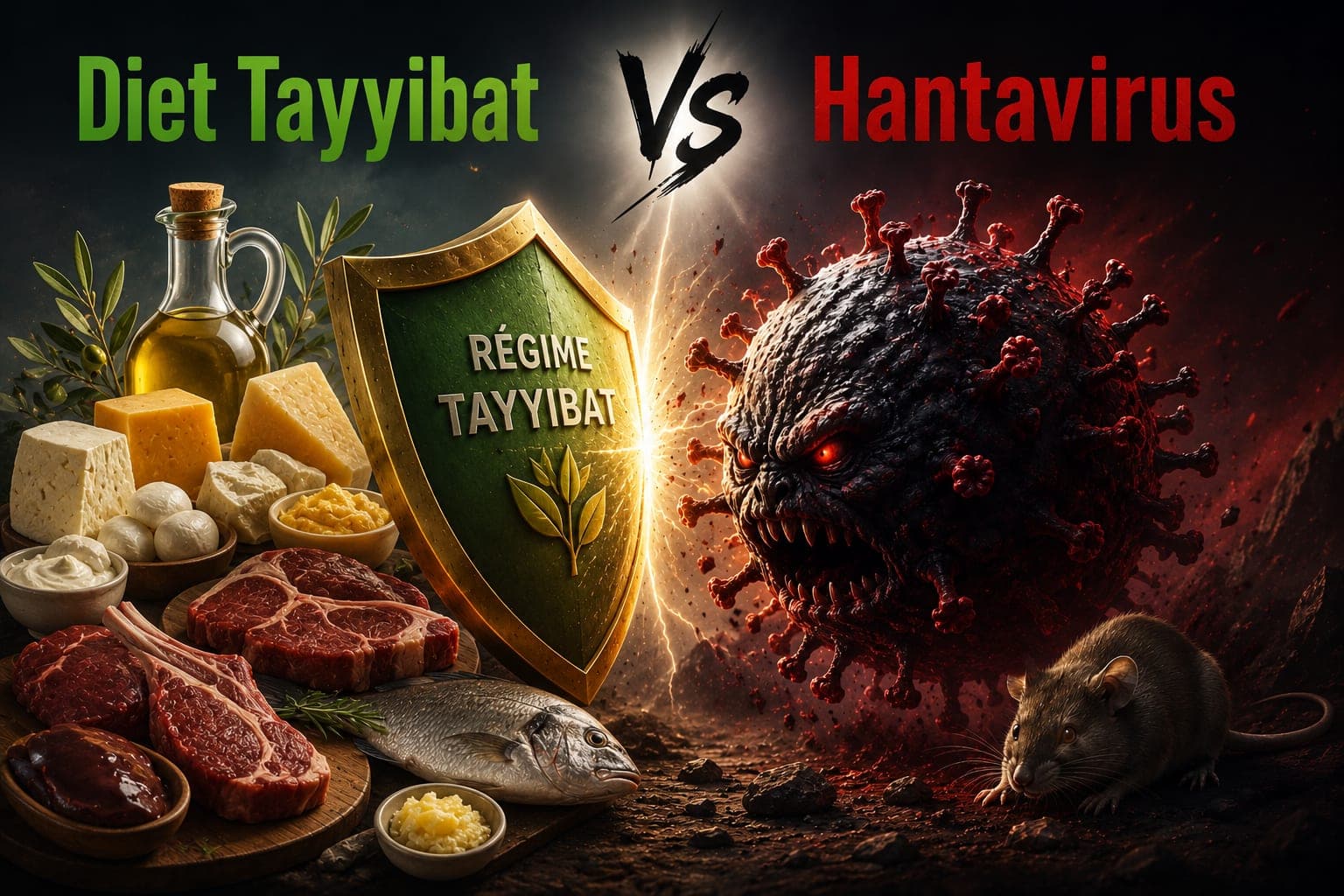
Hantavirus is a serious but rare virus transmitted by rodent excretions. No widely available vaccine, no fully effective antiviral. Prevention is environmental and non-negotiable. But once exposed, two bodies do not respond the same way. Here is what determines that difference, and how the Tayyibat method builds an immune terrain that complements, never replaces, prevention.
What is hantavirus
Hantavirus belongs to the Hantaviridae family of viruses, transmitted primarily by rodents (mice, rats, voles). It causes two main clinical syndromes: Hantavirus Pulmonary Syndrome (HPS), mostly found in the Americas, with a case fatality rate of 30 to 50 percent; and Haemorrhagic Fever with Renal Syndrome (HFRS), more common in Europe and Asia, with milder forms most often, but severe cases possible. The WHO monitors outbreaks closely. Cases in humans remain globally rare, but the severity of complications makes it a public health subject taken seriously by sanitary authorities everywhere.
Transmission and warning symptoms
Transmission happens almost entirely by inhaling aerosolised particles of rodent urine, saliva or dried droppings, typically when cleaning cellars, attics, sheds, barns or any space left closed for a long period in the presence of rodents. The virus is not transmitted by food, water, mosquito bites, or normally between humans. After an incubation of one to eight weeks, the infection often opens like a banal flu syndrome: fever, muscle pain, headache, fatigue. The alert signs come in the days that follow: growing respiratory difficulty, unusual bleeding, sudden drop in blood pressure, reduced urine output, swelling. Any fever after possible rodent exposure must be evaluated by a doctor without delay.
First line of defence: environmental prevention is not negotiable
There is no widely available vaccine and no fully effective specific antiviral against hantavirus. Prevention rests entirely on practical measures: aerate closed spaces abundantly before entering after long inoccupation; never sweep rodent droppings dry, use diluted bleach, disposable gloves and an FFP2 mask; store all food in airtight containers; seal rodent entry points; avoid handling dead rodents bare-handed; in rural or agricultural settings, wear protective equipment when manipulating hay, wood or old stocks. These are the non-negotiable barriers. No diet, however rigorous, replaces them.
Second line of defence: your immune terrain
Once exposure occurs, two bodies do not respond the same way. The COVID-19 pandemic was a global natural experiment on this point. Williamson et al. (Nature 2020, OpenSAFELY cohort, 17 million adults) and Stefan et al. (Lancet Diabetes & Endocrinology 2020) showed that metabolic health, glycaemic balance, body composition and chronic low-grade inflammation, were among the strongest predictors of severe forms across all infections, independent of age. The same is true for influenza, RSV and probably for hantavirus complications. The chronic inflammation built silently year after year by a poor diet is exactly what drains immune capacity when the body is challenged.
Why industrial food weakens the terrain (the Tayyibat exclusion list)
The Tayyibat method excludes more than mainstream nutrition typically does, and for reasons that converge with immune science. Industrial chicken, duck and turkey (Ross 308 breed at 35 days, fed soy meal, residual antibiotics): the omega-6 to omega-3 ratio of an industrial egg or chicken is around 19 to 1, against 3 to 1 for a free-range one (Simopoulos, Experimental Biology and Medicine 2010). This ratio drives chronic low-grade inflammation (Calder, Biochemical Society Transactions 2017). All commercial eggs (industrial and most farm) are excluded in Tayyibat for the same reason. Industrial seed oils, sunflower, corn, soya, deliver omega-6 ratios up to 60 to 1, equally pro-inflammatory. Refined sugars feed bacterial dysbiosis (Sonnenburg, Cell Host & Microbe 2014). Ultra-processed foods (NOVA group 4) are now strongly associated with mortality and disease through inflammation pathways (Pagliai, BMJ 2019 meta-analysis on 105 million people). Each of these foods, repeated daily, builds an inflammatory ground that turns any infection more dangerous.
What the Tayyibat method builds: anti-inflammatory immune terrain
The Tayyibat protocol concentrates the foods science most strongly associates with immune resilience. Daily 50 to 65 grams of true extra-virgin olive oil: oleocanthal acts as a natural COX inhibitor like ibuprofen (Beauchamp, Nature 2005), hydroxytyrosol is an EFSA-recognised LDL antioxidant. Wild Mediterranean fish two to three times a week: long-chain omega-3 (EPA, DHA) directly suppress inflammatory cytokines. Lamb and goat from grazing animals, ranked as primary land protein: rich in zinc (critical for T-cell function), vitamin B12, and bioavailable iron. Liver once a week: ultra-dense in vitamin A (master immune regulator), B12 and selenium. Dates and pomegranate as the sweet pole: rich in polyphenols. Aged raw-milk cheeses provide live cultures that support the gut microbiome. None of this is exotic. It is the food chain our great-grandparents lived on, before industry replaced it.
The 2-hour rule: a daily anti-inflammatory reset
Beyond food choice, the Tayyibat 2-hour rule (no food between meals, only water or unsweetened tea) lowers daily insulin exposure. Chronic hyperinsulinaemia drives systemic inflammation, gut barrier breakdown and immune dysregulation (Lustig and others). The 2-hour rule restores the migrating motor complex, the digestive cleaning cycle that snacking breaks (Vantrappen, J Clin Invest 1977; Pimentel, American Journal of Gastroenterology 2020), preventing small intestinal bacterial overgrowth that feeds chronic immune activation. Yearly, the practising Muslim adds 130 to 170 fasting days (Ramadan, Mondays and Thursdays, white days, six of Shawwāl) which trigger autophagy, the cellular cleaning Ohsumi won the 2016 Nobel for. All this builds an immune system that is rested and ready.
Vigilance and terrain: the real double rampart
No diet, however rigorous, replaces environmental prevention against hantavirus. If you live in a rodent zone, clean with proper protection, aerate your spaces, secure your stocks. These are your first barriers, non-negotiable. But cultivating a strong immune terrain, in the sense of the Tayyibat method, is to give your body the best possible conditions to respond, the day any infection, hantavirus or other, presents itself. An immune capacity built over years of right eating does not replace prevention. It completes it. In this complementarity, vigilance and terrain, lies what the Tayyibat system calls the true balance of health. For complete protocol with weekly menus, country sourcing and family adaptations, see the Sehtin Tayyibat guide.
Continue reading on the Sehtin journal
context
Ebola, the Cytokine Storm, and the Tayyibat Immune Terrain
Ebola is a serious filovirus that, in its worst forms, kills 50 to 90 percent of those infected. A vaccine exists for the Zaire strain, none yet for Sudan. Prevention rests on barrier protocols, not on diet. But once exposed, two bodies do not respond identically. Here is what determines that difference, and how the Tayyibat method builds an immune terrain that complements, never replaces, prevention.
context
Tayyibat in the UAE: Dubai & Abu Dhabi
Dr Diaa Al-Awadi himself practised in Dubai for years. UAE is one of the markets where Tayyibat has the deepest organic roots. Premium ingredients are widely available, the qahwa-and-dates ritual aligns perfectly with the 2-hour rule, and Ramadan accelerates the protocol naturally.
context
Tayyibat in Cairo & Alexandria
Egypt is the birthplace of Tayyibat. Cairo and Alexandria offer the deepest sourcing ecosystem in the Arab world for real lamb, traditional olive oil, baladi bread, freekeh and aged cheese, often at a fraction of European or Gulf prices.
This article relays the public teachings of Dr. Diaa Al-Awadi for educational and informative purposes. It is not medical advice. Consult your physician before any dietary change. Legal notice.